
Is It Worth Repairing Your Zero-Turn — or Time for a Ferris or Scag?
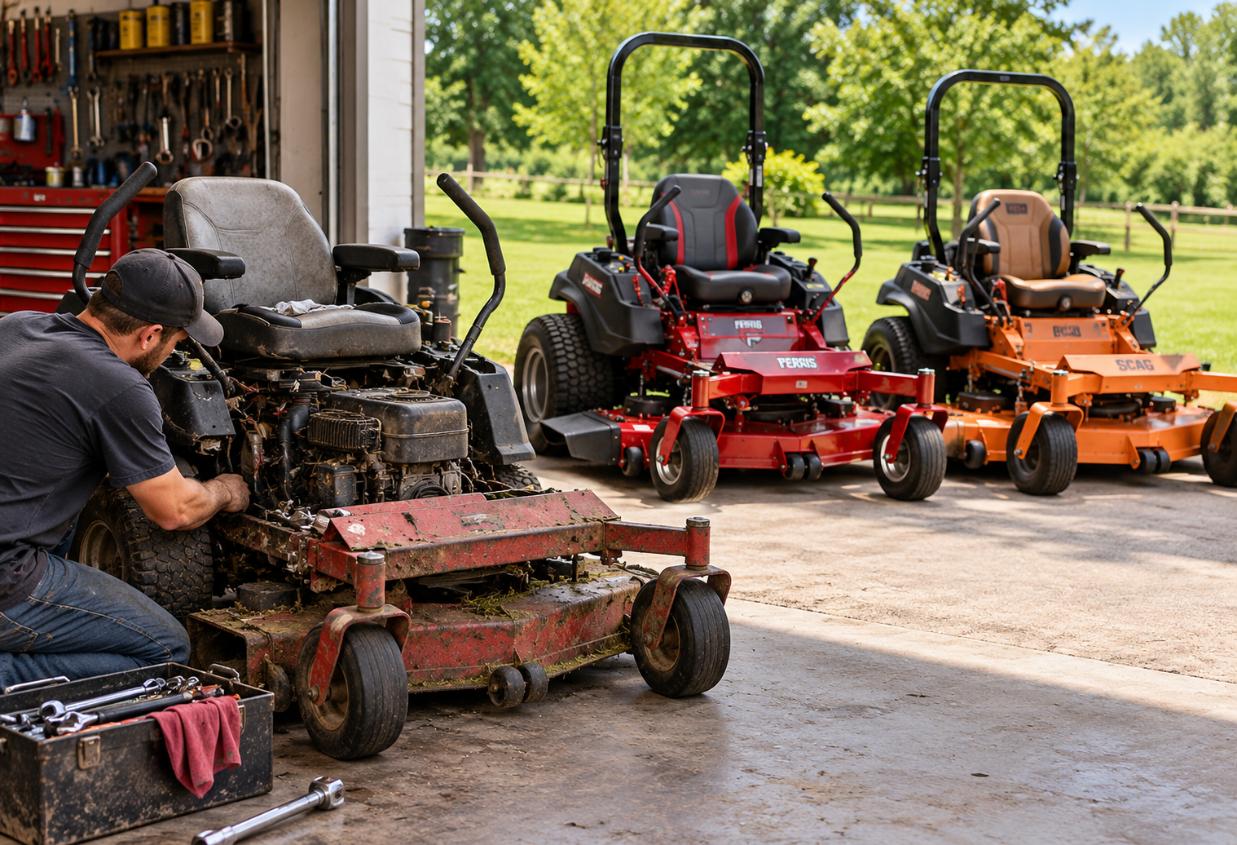
A zero-turn mower that starts needing repairs every mowing season can put property owners in a tough spot. Around Bells, long growing seasons, summer heat, frequent rainfall, and larger rural properties can put plenty of hours on mowing equipment.
The question is not simply whether your mower can be repaired. The better question is whether repairing it still makes financial and practical sense compared with moving into a newer machine, including a Ferris or Scag.
Quick answer: Repairing your zero-turn usually makes sense when the engine, hydrostatic drive system, deck, and frame are fundamentally sound and the repair restores dependable operation. Replacement becomes more attractive when major systems are wearing out together, repairs are becoming frequent, or downtime is interfering with the amount of mowing you need to get done.
What local mower owners should know
-
One expensive repair does not automatically mean a zero-turn needs to be replaced.
-
Repeated engine, hydro, spindle, deck, and electrical problems can signal that the machine is entering a more expensive stage of its life.
-
Mowers used on larger properties around Bells and Crockett County may accumulate hours much faster than machines used on small residential lawns.
-
Wet spring growth and hot Tennessee summers can make reliability especially valuable during peak mowing season.
-
Comparing the condition of your current mower with the cost and capabilities of a Ferris or Scag can provide a clearer answer than looking at the repair bill alone.
Why Does the Repair-or-Replace Decision Matter Around Bells?
The repair-or-replace decision matters around Bells because a mower that is unreliable during the growing season can quickly create more work for property owners. Grass growth can accelerate during warm, wet stretches, leaving less room in the schedule for a zero-turn that repeatedly needs repairs.
Bells is in Crockett County, with nearby communities including Alamo, Gadsden, Maury City, Humboldt, and Brownsville. Properties throughout this part of West Tennessee range from residential lawns to larger rural acreage, so mower workloads can vary considerably.
NOAA 1991-2020 climate normals from the nearby Alamo weather station show July average highs near 89°F and annual precipitation of roughly 54 inches. May averages more than five inches of precipitation. Those warm, wet conditions help explain why dependable mowing equipment matters through much of the growing season.
At Hill’s Repair Shop, we believe the decision should start with the condition of the machine you already own. A proper evaluation can help determine whether another repair is sensible or whether your money may be better directed toward replacement.
What Does the Condition of Your Zero-Turn Tell You?
The overall condition of your zero-turn is usually more important than its age alone when deciding whether to repair or replace it. A well-maintained older mower with a solid frame, healthy engine, good hydros, and serviceable deck may still have useful life left.
Hours matter, but those hours do not tell the entire story. Maintenance history, mowing conditions, previous repairs, storage, and how heavily the machine has been used all affect its condition.
Around Bells, we would pay particular attention to the engine, hydrostatic system, deck structure, spindles, belts, pulleys, electrical system, steering components, and frame. A mower needing one isolated repair presents a very different decision from one with wear developing across several major systems.
What Warning Signs Suggest Your Zero-Turn May Be Nearing Replacement?
Repeated failures, declining performance, and major wear in several systems are strong signs that replacing a zero-turn deserves serious consideration. The goal is to identify whether you are fixing one problem or continually putting money into a machine whose overall condition keeps deteriorating.
Watch for signs such as:
-
The mower needs significant repairs multiple times during the season.
-
One or both hydro drives feel weak, inconsistent, or noticeably different from before.
-
The engine consumes excessive oil, smokes, loses power, or develops recurring problems.
-
The deck has significant structural damage or deterioration.
-
Spindles, bearings, pulleys, and belts require increasingly frequent attention.
-
Electrical problems repeatedly prevent reliable starting or operation.
-
Steering performance has deteriorated despite normal adjustments.
-
Repair downtime regularly interferes with keeping your property mowed.
None of these signs automatically means replacement is required. Several occurring together, however, can change the economics of another repair.
When Should You Have a Zero-Turn Professionally Evaluated?
A professional evaluation makes sense when the repair involves the engine, hydrostatic drive, structural deck components, recurring electrical problems, or several failures at once. These systems can significantly affect the real cost of keeping an older zero-turn operating.
Owners can safely monitor basic items such as tire condition, obvious belt wear, fluid levels where applicable, blade condition, and unusual sounds. Routine cleaning and manufacturer-recommended maintenance also help reveal developing problems.
Diagnosis should go further when the mower loses drive power, repeatedly throws belts, produces abnormal engine noise, leaks heavily, cuts unevenly despite normal maintenance, or has a recurring problem that previous repairs have not resolved.
What Common Problems Push Zero-Turn Owners Toward Replacement?
The problems most likely to push owners toward replacement are major engine or hydro repairs combined with additional wear elsewhere on the mower. A single failed component may still be worth repairing, but several expensive systems approaching the end of their useful service life create a different calculation.
1. Hydrostatic drive problems: Weak or failing drive components can substantially affect how the mower performs and whether another major repair makes sense.
2. Engine problems: Internal engine trouble becomes more significant when the mower also has high hours or considerable wear elsewhere.
3. Deck deterioration: A mower may have a running engine but still need substantial deck work involving spindles, bearings, pulleys, mounts, or structural components.
4. Accumulated smaller failures: Batteries, switches, wiring, belts, bearings, tires, and other individual repairs may be manageable separately. When they keep arriving one after another, total ownership cost begins to change.
Can Maintenance Keep a Zero-Turn Worth Repairing Longer?
Consistent maintenance can extend the useful life of a zero-turn and reduce the chance that several preventable problems appear at once. That is especially useful in West Tennessee, where mowing equipment can see regular use from spring through the warmer months.
Before peak mowing season, inspect belts, blades, tires, filters, fluids, deck components, and visible wiring. Keep grass buildup from accumulating around areas identified for cleaning in the owner’s manual, and follow the manufacturer’s maintenance schedule for the engine and drive system.
During heavy spring growth around Bells and Alamo, pay attention to changes in sound, vibration, steering, cut quality, and drive performance. Small symptoms are usually easier to evaluate before they become a breakdown in the middle of mowing.
DIY maintenance should stop when diagnosis requires disassembling major engine or hydro components, addressing significant electrical faults, or performing repairs beyond the procedures and safety instructions provided by the manufacturer.
What Results Should You Expect From a Worthwhile Zero-Turn Repair?
A worthwhile repair should correct a defined problem and return the mower to dependable service without immediately exposing a long list of additional major failures. The value of the repair comes from the usable service you expect to receive afterward, not simply from getting the mower running again today.
For example, repairing a deck component on an otherwise healthy mower can be a straightforward decision. Paying for substantial hydro work on a mower that also has serious engine and deck problems may require a closer comparison with replacement.
The right answer depends on diagnosis, parts needs, overall condition, and how much dependable mowing you need from the machine.
What Mistakes Should You Avoid When Deciding Between Repair and Replacement?
The biggest mistake is deciding based only on today’s repair estimate instead of evaluating the entire mower. A lower repair bill can look attractive until another worn system fails a few weeks or months later.
Mistake: Looking only at the mower’s age.
Consequence: You may replace a solid older machine unnecessarily.
Better approach: Consider condition, hours, maintenance history, and major component health together.
Mistake: Looking only at the latest repair cost.
Consequence: You may overlook several additional systems nearing repair.
Better approach: Evaluate the mower as a complete machine.
Mistake: Buying a replacement based only on price.
Consequence: The new mower may not match your acreage, terrain, workload, or comfort needs.
Better approach: Compare mower specifications and support against how you actually mow.
What Is a Common Repair-or-Replace Scenario Around Bells?
A common local scenario is an older zero-turn that develops one significant problem after several seasons of mowing a larger property around Bells or Crockett County. The owner wants to know whether paying for the repair buys meaningful additional service life or simply postpones replacement.
Suppose the mower needs drive-system work. If the engine runs well, the deck is solid, the frame is sound, and the rest of the machine has been maintained, repairing it may still be reasonable.
If that same mower also has engine problems, a worn deck, recurring electrical faults, and several overdue components, comparing replacement options becomes more useful.
That is a scenario, not a specific Hill’s Repair Shop customer case.
How Can Hill’s Repair Shop Help With the Decision?
A mower evaluation can help separate a repairable problem from broader wear that may make replacement worth considering. We can look at the condition of the machine and help you understand what is failing before you commit money to the next step.
For owners considering replacement, Ferris and Scag both offer zero-turn mower lines with models designed for different property sizes and workloads. Ferris highlights suspension technology across its mower lineup, while Scag offers residential and commercial-oriented zero-turn models across several product families.
The right mower should be selected according to acreage, terrain, deck size, expected annual use, serviceability, comfort, and available support rather than brand name alone.
Is Repairing Your Current Mower Better Than Buying a Ferris or Scag?
Repair is usually the stronger option when the mower remains mechanically sound overall, while replacement deserves consideration when reliability and major-component wear are becoming recurring problems. Comparing both choices side by side can keep one repair bill from making the decision for you.
| Consideration | Repair Current Zero-Turn | Consider Ferris or Scag |
|---|---|---|
| Overall mower condition | Better fit when major systems remain healthy | Worth considering when several major systems are worn |
| Repair frequency | Makes sense when failures are occasional | More relevant when repairs are recurring |
| Downtime | Reasonable when repairs restore dependable use | May reduce dependence on an increasingly unreliable machine |
| Property needs | Works if the current mower still fits the job | Opportunity to reconsider deck size, comfort, and workload |
| Upfront expense | Usually avoids a full replacement purchase | Requires a larger purchase decision |
| Long-term planning | Useful when meaningful service life remains | Useful when the current mower no longer meets your needs |
Ferris emphasizes its suspension systems as a feature intended to improve ride characteristics. Scag offers multiple zero-turn families ranging from the Liberty Z through heavier-duty models. Specific model, engine, deck, warranty, and availability details should be confirmed for the machine being considered.
What Areas Can Local Zero-Turn Owners Consider This Advice For?
This repair-or-replace approach applies to mower owners throughout Bells and surrounding West Tennessee communities with similar mowing conditions. That includes property owners around Alamo, Gadsden, Maury City, Humboldt, Brownsville, and other nearby parts of Crockett and Haywood counties.
The exact answer still depends on the mower and how it is used.
What Can Waiting Too Long to Address Mower Problems Cost?
Waiting on a developing zero-turn problem can increase downtime and may allow related components to experience additional wear. That matters during the West Tennessee growing season, when losing a mower for an extended period can leave a larger property increasingly difficult to catch up on.
Ignoring unusual vibration, drive changes, bearing noise, belt problems, leaks, or engine symptoms can also make diagnosis harder once the machine stops operating altogether.
Getting the problem evaluated does not commit you to repairing or replacing the mower. It gives you better information for making the decision.
FAQ
Is an old zero-turn mower worth repairing in Bells, TN?
An older zero-turn can be worth repairing in Bells if its major systems are still in good condition and the repair addresses an isolated problem. Age by itself is not enough to make the decision. Engine health, hydro condition, deck condition, hours, maintenance history, and expected future repairs provide a better picture.
How do I know when my zero-turn is not worth fixing?
A zero-turn becomes harder to justify repairing when several expensive systems need attention and additional failures are likely. Major engine, hydro, and deck problems occurring together deserve a full repair-versus-replacement comparison rather than automatically authorizing the next repair.
Does the West Tennessee mowing season affect mower wear?
West Tennessee conditions can contribute to substantial seasonal mower use because warm temperatures and regular rainfall support grass growth. Around Bells, nearby NOAA climate normals show warm summers and annual precipitation of roughly 54 inches, making routine maintenance especially useful for equipment that sees frequent mowing.
Should I repair a bad hydro on my zero-turn?
A hydro repair may make sense if the rest of the mower remains in strong condition. If the engine, deck, frame, and other drive components are also heavily worn, the total condition of the mower should be considered before investing in a significant repair.
Should I consider Ferris for a larger property near Bells?
Ferris offers zero-turn models intended for a range of mowing workloads, so the appropriate choice depends on acreage, terrain, deck requirements, and expected use. Ferris specifically emphasizes suspension technology in its mower lineup, which may be a consideration for owners mowing rougher ground.
Should I consider a Scag zero-turn in Crockett County?
Scag offers several zero-turn product families that can be compared according to property size and workload. For Crockett County owners, useful comparison points include deck width, engine configuration, drive system, serviceability, comfort, terrain, expected mowing hours, and access to parts and service.
What size zero-turn do I need around Bells?
The appropriate deck size depends on your mowable acreage, gates, obstacles, terrain, storage space, and transportation needs. A wider deck can increase productivity on open acreage, while a smaller machine may be easier to maneuver around landscaping, buildings, fences, and tighter areas.
Should I repair my mower before spring mowing starts?
Addressing known problems before heavy spring mowing can reduce the chance of losing the machine when grass growth accelerates. For Bells-area owners, preseason inspection is a practical time to check blades, belts, tires, fluids, filters, deck components, and symptoms that appeared during the previous season.
Make Your Next Mowing Season More Dependable
Whether your current zero-turn needs one sensible repair or has reached the point where replacement deserves consideration, understanding the machine’s overall condition gives you a better basis for deciding.
For mower owners in Bells and surrounding West Tennessee communities, we can help evaluate the equipment you already have and discuss the next step based on its condition and your mowing needs.
Find the Right Next Step for Your Zero-Turn
Get a clearer picture of whether your mower is worth repairing or whether it is time to explore a Ferris or Scag.